Coat of Arms History
G.W.G Bowen and Legacy of Griffith Bowen of Barryhead
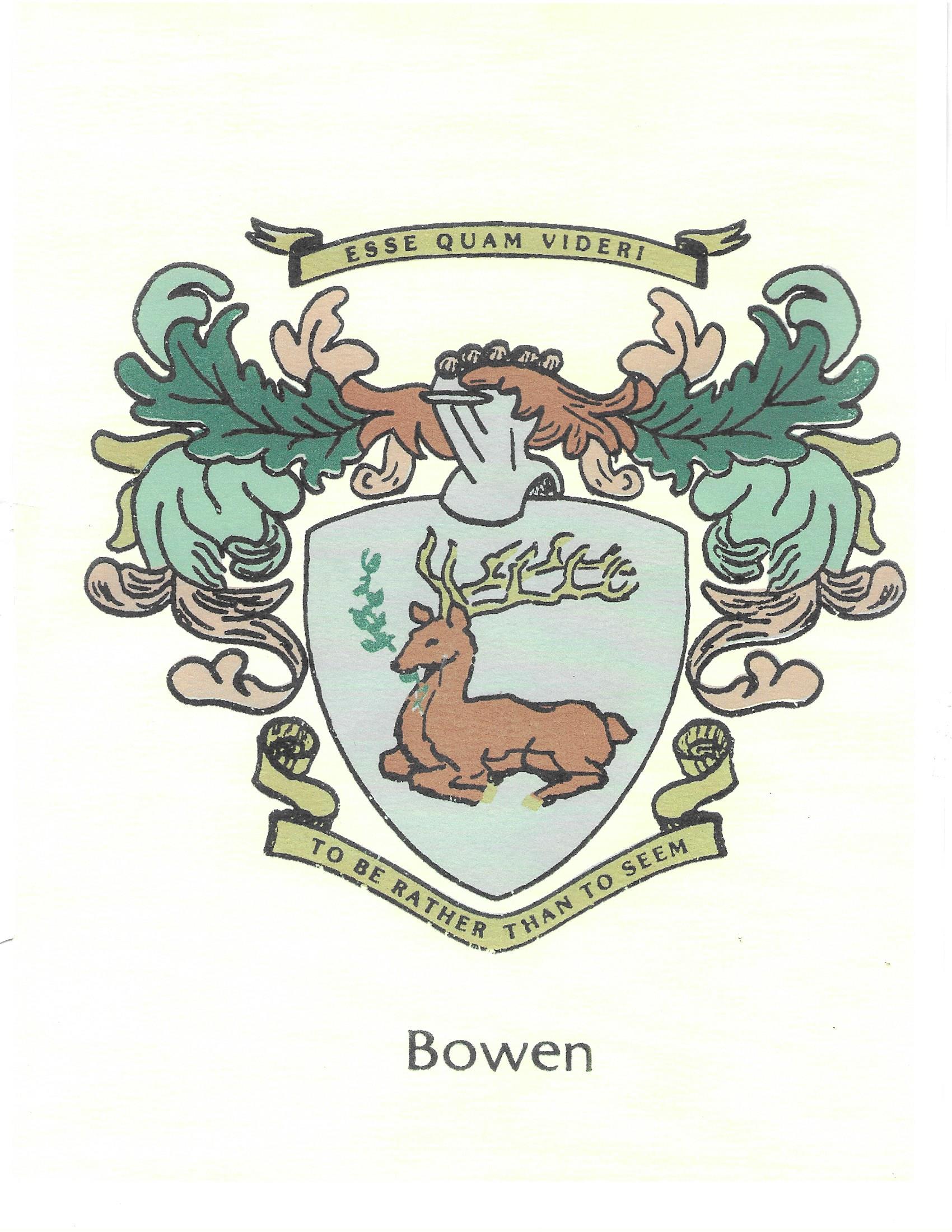
by Virginia Ann Campbell (Lavelle) Admire (1939–2000)
The coat of arms displayed by the G.W.G. Bowen Homestead was designed and painted by Virginia Ann Campbell (Lavelle) Admire (1939–2000); born in Vineland, New Jersey; died in Cape Coral, Florida.
Virginia “Ginny” Admire designed and painted the coat of arms circa 1957 as part of her physical therapy while recovering from polio, which helped her learn to use her left hand. Her mother, Dorothy Campbell, and grandmother, Bessie Courter, enlisted her to create the design, which she derived from the 1955 Bowen Book they had previously compiled. This undertaking allowed Virginia to utilize photographs of the original family crest from her mother’s research.
The image was rendered from the authentic coat of arms and crest belonging to Griffith Bowen of Barryhead. This specific achievement represents the true heraldic signature of his lineage, distinguishing him from other Bowen branches in Wales.
Here is the historical narrative and symbolic story behind this coat of arms.
The Legacy of Bleddyn ap Maenyrch
The story of this shield begins long before the surname “Bowen” even existed. In the rugged hills of medieval Wales, armor and crests were not tied to modern family names, but to noble tribal patriarchs.
Griffith Bowen’s lineage traced directly back to Bleddyn ap Maenyrch, the last independent Lord of Brecknock (Brecon) in the 11th century. When the Norman invaders pushed into Wales, Bleddyn fiercely defended his lands. Though Bleddyn fell in battle around 1093, his descendants preserved his memory through heraldry. For centuries, anyone carrying his bloodline had the right to bear his traditional symbols.
Symbolism of the Shield: The Stag Couchant
While the principal medieval shield of Bleddyn’s house featured three golden fleurs-de-lis, the Bowen family of Slade and Barryhead uniquely elevated the stag couchant (lying down) holding a sprig or olive branch in its mouth as their primary emblem and crest.
Every element of this design carries profound medieval meaning:
- The Stag Couchant: In heraldry, a stag represents administrative wisdom, a noble spirit, and a person who will not fight unless provoked. By depicting the stag couchant (peacefully resting) rather than trippant (running) or at gaze (alert), the family symbolized achieved peace, security, and a quiet, unshakeable strength.
- The Green Branch: The sprig or olive branch clutched in the stag’s mouth represents peace, growth, and rebirth. It honors a lineage that survived the turbulent Welsh-Norman wars and managed to thrive, put down deep roots, and bring harmony to the Gower Peninsula of Glamorgan.
- The Mantling: The flowing green and gold fabric surrounding the helmet represents the protective cloak worn by medieval knights. Slit and shredded mantling in heraldry traditionally mimicked a cloak hacked by swords in battle—a badge of honor showing the family’s willingness to fight for their sovereign.
The Motto: Esse Quam Videri
Emblazoned on the scrolls at both the top and bottom is the family motto: “Esse Quam Videri”, translated directly underneath as “To Be Rather Than To Seem.”
This famous Latin phrase originates from the Roman philosopher Cicero’s essay On Friendship. For a prominent gentry family like the Bowens of Glamorgan, it was a statement of profound moral philosophy. It declared to the world that they valued substance over flash, authentic virtue over empty titles, and true honor over public vanity.
The Transatlantic Journey
In 1638, Griffith Bowen took a massive gamble. Driven by his Puritan faith and a desire for religious freedom, he packed his life and his heritage onto a ship and sailed across the Atlantic to the Massachusetts Bay Colony.
In the untamed wilderness of New England, titles of British nobility meant very little, but the philosophy of Esse Quam Videri (“To Be Rather Than To Seem”) perfectly matched the rugged, deeply pious Puritan work ethic. Griffith’s descendants would later move to Woodstock, Connecticut, carrying records of this exact coat of arms with them.
By the late 19th and early 20th centuries, as G.W.G. Bowen descendants sought to reconnect with their Welsh roots, Virginia Admire hand-painted this Coat of Arms, preserving the resting stag and the timeless reminder, “To be rather than to seem”—to live an authentic, honorable life.